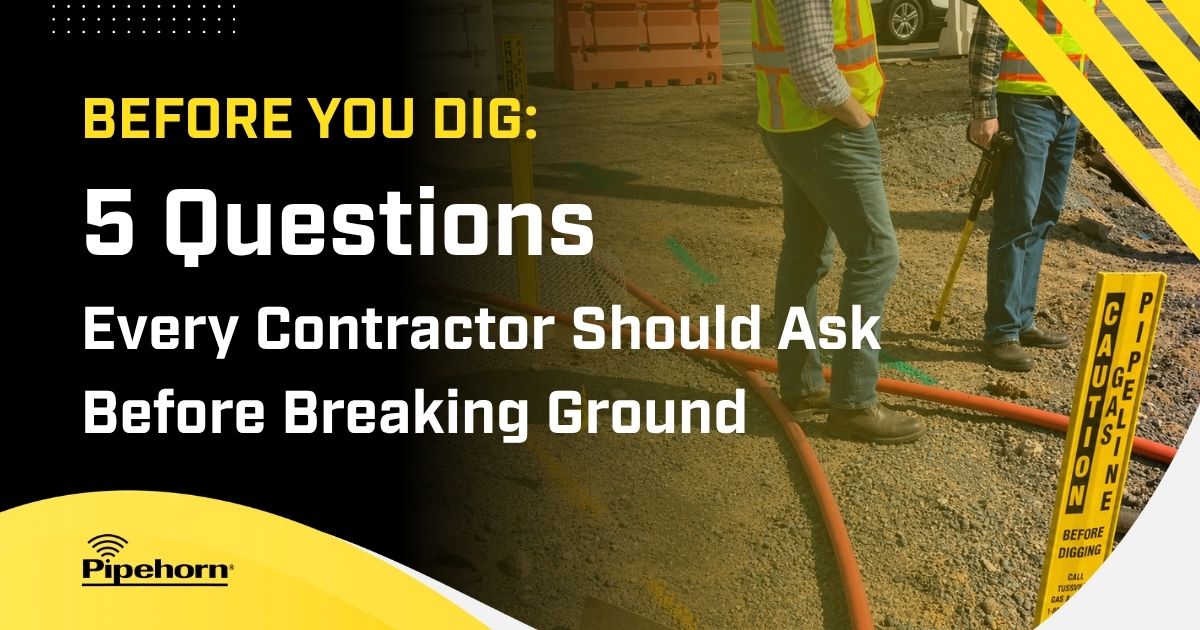
Before You Dig: 5 Questions Every Contractor Should Ask Before Excavation
Before You Break Ground
Every excavation project begins with decisions that affect the safety of everyone on the jobsite.
Whether you’re digging, trenching, directional drilling (HDD), grading a site, installing underground infrastructure, or preparing a jobsite for construction, your responsibility is the same: making sure it’s safe to break ground.
Striking a buried utility can create serious safety hazards for equipment operators, ground crews, nearby residents, and the critical infrastructure our communities depend on. It can also delay projects, increase costs, and disrupt essential services.
Utility markings provide valuable information, but experienced crews know additional verification can help reduce risk before excavation begins.
Before breaking ground, ask these five questions.
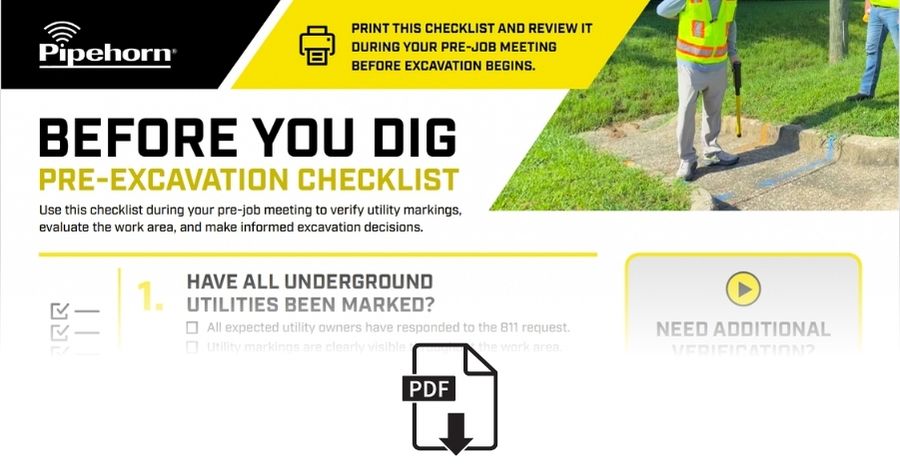
⬇️ Download the Before You Dig: Pre-Excavation Checklist
Want a printable version to use during pre-job meetings? Download the Before You Dig: Pre-Excavation Checklist and review it with your crew before excavation begins.
✔ Printable PDF
✔ Pre-job meeting tool
✔ Based on CGA Best Practices
1. Have All Underground Utilities Been Marked?
Every safe excavation project starts with understanding what’s beneath the jobsite.
Before breaking ground, contact your local one-call notification center (811) and wait until all applicable utility owners have responded to your locate request.
Utility locating and utility markings provide the first layer of information by identifying the approximate location of underground gas, water, electric, sewer, and telecommunications infrastructure that could be affected by excavation.
Before moving equipment into position, ask:
- Have all expected utility owners responded to the 811 request?
- Are all utility markings clearly visible throughout the work area?
- Does everyone on the crew understand what each marking represents?
- Will your planned excavation or bore path cross any marked utilities?
Once utility markings have been reviewed, the next step is evaluating the jobsite and identifying any areas that may require additional attention before excavation begins.
2. Have We Evaluated the Jobsite for Potential Utility Conflicts?
Utility markings are only one source of information.
Before excavation begins, take time to walk the entire jobsite and look for anything that may indicate underground infrastructure or potential utility conflicts.
Pay attention to features such as:
- Utility pedestals
- Transformer pads
- Water meters
- Valve boxes
- Fire hydrants
- Pull boxes and handholes
- Power poles
- Existing utility markings
- Evidence of previous excavation
These visible features can provide valuable context about what may be below ground and help identify areas that deserve additional attention before excavation begins.
Ask yourself:
- Do the visible site conditions match the utility markings?
- Will the planned excavation or bore path cross any visible utility infrastructure?
- Is there anything about the jobsite that requires additional verification before excavation begins?
Walking the jobsite doesn’t replace utility locating—it helps crews better understand the work area before making the decision to excavate.
Once the work area has been evaluated, the next step is determining whether additional verification is needed before excavation begins.
3. When Should Utility Marks Be Verified?
Once utility markings have been reviewed and the jobsite has been evaluated, determine whether additional verification is appropriate before excavation begins.
Many experienced contractors perform a Safety Sweep as an additional layer of verification before the first shovel, bucket, auger, trencher, or drill head enters the ground.
A Safety Sweep uses utility locating equipment to help verify marked utilities and identify potential utility conflicts that may require further investigation before excavation begins.
It can provide additional information in areas with congested underground infrastructure, multiple utility crossings, private utilities, complex excavations, changing site conditions, or other conditions that warrant a closer look.
The goal isn’t to question the utility markings—it’s to better understand how underground utilities may affect the planned excavation.
A Safety Sweep can help crews:
- Verify the location of marked utilities.
- Identify areas where underground utilities may be congested.
- Recognize locations that may require potholing or vacuum excavation.
- Support safer, more informed excavation decisions.
Additional verification doesn’t mean the original utility markings are incorrect. It simply provides another layer of information to help crews make informed excavation decisions.
Once areas requiring additional attention have been identified, the next step is determining whether utilities should be visually verified before digging.
Watch how easy it is to verify utility marks before excavation with Pipehorn:
4. Should We Pothole or Vacuum Excavate Before Digging?
When directional drilling or excavation will expose or cross underground utilities, visual verification may be the safest next step before continuing work.
Potholing or vacuum excavation allows crews to visually verify the location of critical underground utilities before excavation or drilling continues.
This visual verification may be appropriate when:
- Crossing existing utilities
- Multiple underground utilities occupy the same area
- The planned excavation or bore path passes near critical infrastructure
- Existing utilities are closely spaced
- Underground utilities cannot be confidently avoided using surface markings alone.
Visually verifying critical utilities before excavation continues provides one more layer of confidence before moving forward.
5. If Conditions Change, Will We Stop and Reevaluate?
Safe excavation doesn’t end once the digging starts.
Unexpected conditions can arise at any point during a project.
If excavation reveals an unexpected utility, existing conditions don’t match the utility markings, or something doesn’t look right, stop work and evaluate the situation before proceeding.
Communicate with the appropriate people, determine whether additional locating, visual verification, or coordination is needed, and continue only when it’s safe to do so.
Safe Excavation Is Built on Layers of Verification
Safe excavation doesn’t rely on a single step. It relies on a process of gathering information, verifying underground utilities, and making informed decisions before—and throughout—excavation.
Whether you’re breaking ground for commercial construction, residential construction, site development, roadway projects, utility installation, or municipal infrastructure work, each layer of verification helps crews better understand the work area before excavation begins.
The process starts with requesting utility markings, but it doesn’t end there. Walking the jobsite, performing a Safety Sweep, visually verifying utilities when appropriate, and remaining alert to changing conditions all help crews reduce uncertainty and support safer excavation before and throughout the project.
Most importantly, safe excavation is a shared responsibility. Utility owners, locators, supervisors, equipment operators, and ground crews all play an important role in protecting underground infrastructure and the people working around it.
No matter the size of the project or what’s being built, safe excavation starts long before the first bucket enters the ground. It starts with preparation, verification, communication, and a commitment to making informed decisions before—and throughout—excavation. Because at the end of the day, the goal isn’t simply to complete the project. It’s to make informed decisions that help every member of the crew return home safely.
Industry Best Practice
The Common Ground Alliance (CGA) Best Practices emphasize that safe excavation is a shared responsibility and encourage excavators to verify utility markings, exercise care around underground facilities, visually verify utilities when appropriate, and stop work if unexpected conditions are encountered. A Pipehorn Safety Sweep supports these same principles by helping crews gather additional information before excavation begins.
Make Safety Sweeps Part of Every Excavation
A Safety Sweep is one more way contractors can build confidence before breaking ground.
Pipehorn utility locating equipment helps excavation contractors, utility contractors, sitework contractors, HDD crews, municipalities, and public works departments perform fast, practical Safety Sweeps as part of a safer excavation process.
Related Resources
Explore additional resources to help plan safer excavations.
Verify Utility Marks
Watch how crews verify utility marks before excavation using Pipehorn.
Safety Sweep
Learn when additional verification can help crews identify areas that deserve a closer look before excavation.
Locating Tips
Explore field-proven locating techniques, troubleshooting tips, and educational resources.
Free Training
Build your locating skills with hands-on classroom and field training led by Pipehorn experts.