Utility Locator Frequency: When to Use High vs. Low Frequency
Choosing the right frequency can make a big difference in how well a utility locate goes. But higher frequency isn’t always better—and neither is lower frequency.
The reason is simple: no single frequency is ideal for every conductor or locating situation. The best choice depends on what you’re locating, the condition and length of the conductor, surrounding utilities, how you’re applying the signal, and what you’re seeing in the field.
Understanding the advantages of high and low frequencies—and knowing when to switch between them—can help you get a more reliable locate and adapt when conditions change.
Start With How You're Applying the Signal
Before choosing a frequency, consider how you’re going to apply signal to the target.
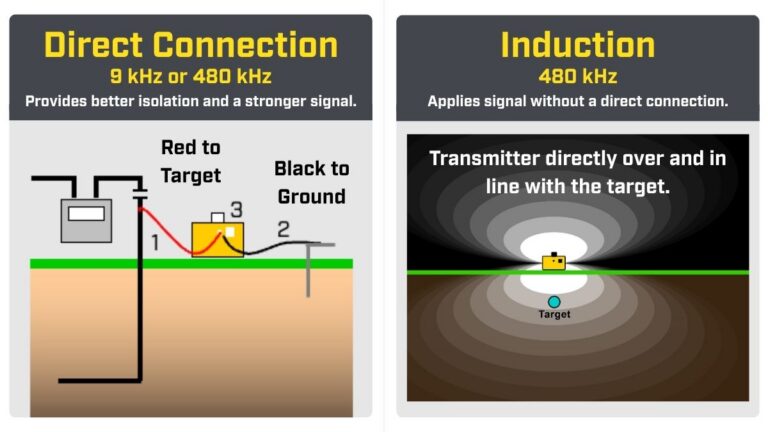
Whenever possible, direct connection is the preferred method. Connecting directly to the target conductor provides better isolation and a stronger signal than induction. With the Pipehorn 800-HL, both 9 kHz low frequency and 480 kHz high frequency are available when you’re direct connected.
When a direct connection isn’t possible, induction allows you to apply signal without physically connecting to the utility. Pipehorn inductive locating uses 480 kHz high frequency. Proper transmitter placement is especially important when inducing signal onto the target.
So, when you can direct connect, that’s always where you want to begin. From there, frequency selection depends on the locate.
When to Start With Low Frequency
When you’re direct connected to a good conductor, low frequency is the recommended place to start.
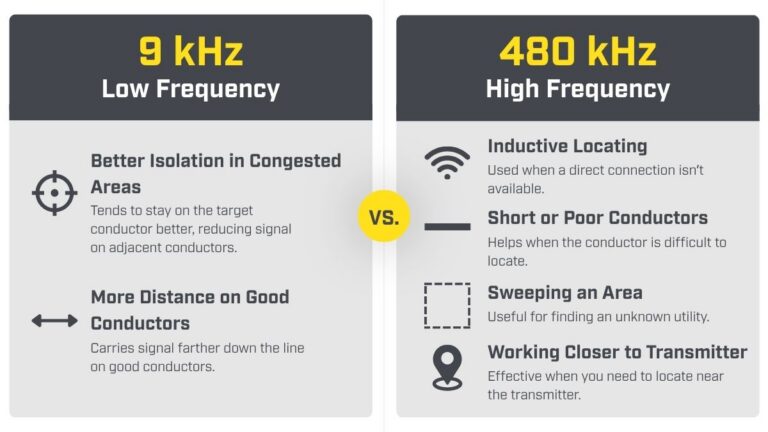
Pipehorn’s 9 kHz low frequency offers two key advantages:
- Better isolation. Low frequency tends to stay on the target conductor better, which can be especially helpful in congested areas where other conductive utilities are nearby.
- More distance on good conductors. When you’re tracing a good conductor over a longer run, low frequency can carry the signal farther down the line.
For example, if you have an accessible connection point and need to trace a utility main a significant distance, 9 kHz would typically be a good starting point.
But starting with low frequency doesn’t mean you don’t have another option to help complete the locate.
When High Frequency Has the Advantage
There are locating situations where high frequency can give you an advantage.
Pipehorn’s 480 kHz high frequency is particularly useful for:
- Inductive locating when a direct connection isn’t available
- Short or poor conductors
- Sweeping an area to identify an unknown utility
- Locating closer to the transmitter
And high frequency isn’t only for induction. You can also direct connect using 480 kHz when the conductor or locating conditions make high frequency the better choice.
That’s why it’s useful to think of frequency selection as a tool rather than a rule. If the frequency you’re using isn’t giving you the information you need, consider whether the conductor or conditions call for a different approach.
Damaged Tracer Wire: A Good Example of When to Switch
Damaged or corroded tracer wire is a good example of why having access to both frequencies can be valuable.
If you can connect to the tracer wire, start with low frequency and follow the conductor as far as you can. When the wire is intact and carrying signal well, low frequency provides the isolation and distance you want.
But damaged tracer wire may reach a point where the low-frequency signal no longer carries effectively.
Rather than assuming you’ve reached the end of the utility, switching to 480 kHz high frequency can give you another way to continue evaluating the line. For damaged tracer wire, start with low frequency and switch to high frequency when the low-frequency signal no longer carries effectively.
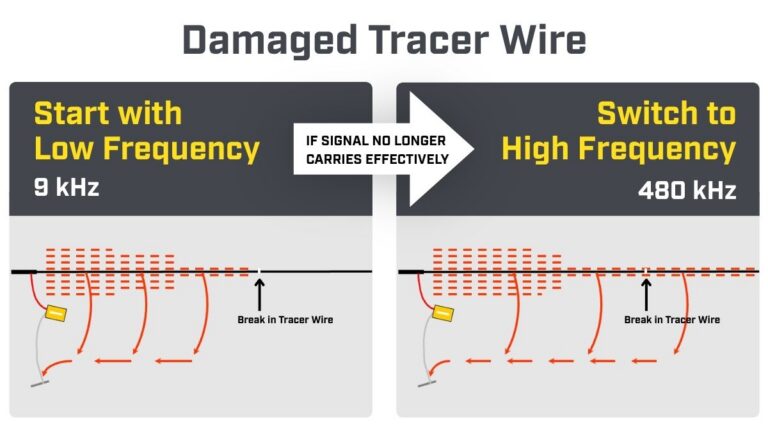
It’s a good illustration of an important locating principle: conditions can change as you move down a line, and your locating approach may need to change with them.
Don't Overlook Your Ground Connection
Frequency isn’t the only thing that affects signal quality.
When you’re direct connected, the quality of your ground connection matters, too. Dry or sandy soil can make establishing a good ground more difficult. If you’re getting poor signal output, adding water around the ground rod can help improve the ground connection.
That’s worth checking before assuming you need to change frequency or that there’s a problem with the equipment.
Which Frequency Should You Use?
There’s no single answer for every locate, but these general guidelines can help:
Locating Situation
Good Starting Point
Long run on a good conductor
9 kHz / Low Frequency
Congested area where better isolation is needed
9 kHz / Low Frequency
No access point; induction is required
480 kHz / High Frequency
Sweeping an area for an unknown utility
480 kHz / High Frequency
Short or poor conductor
480 kHz / High Frequency
Damaged or corroded tracer wire
Start with 9 kHz (LF); switch to 480 kHz (HF) as needed
These aren’t meant to replace what you’re seeing in the field. They’re starting points. The conductor, site conditions, surrounding utilities, and signal response should all inform what you do next.
Why Two Frequencies?
Pipehorn’s approach to frequency goes all the way back to the company’s beginning.
In 1968, Alabama Gas employee Tom Humphries was trying to solve a specific locating problem: the locators available at the time weren’t performing well on cast iron pipe with insulated joints. He set out to develop a locator that would perform better on those difficult conductors.
Today’s locators encounter their own poor conductors—including damaged or degraded tracer wire and tracer tape, street and parking lot lighting, short side services, stub outs, and fiber optic lines with minimal metallic content.
The Pipehorn 800-HL gives locators access to both 9 kHz low frequency and 480 kHz high frequency because each has advantages in different locating situations.
The question isn’t which frequency is better.
It’s which frequency is better for the locate in front of you.
Keep Building Your Locating Skills
Frequency selection is one part of an accurate locate. Understanding how your signal is applied, recognizing what the receiver is telling you, and adjusting your approach to field conditions all play a role.
Visit the Pipehorn Locator Learning Center for locating techniques, troubleshooting resources, application guides, field videos, training resources, and more.