Locators usually notice the problem before they understand the cause. Common field symptoms include:
The target shifts several feet when you change direction
The signal suddenly becomes stronger near another utility
The signal continues past the expected endpoint
A second line appears parallel to the first
The signal will not stay centered over the path
If you see multiple symptoms, the receiver is likely tracking current on an adjacent conductor instead of the target utility.
What is Signal Bleed-Over?
Signal bleed-over occurs when the transmitter’s electrical current transfers from the intended utility to a nearby conductor.
The locator follows the electrical field — not the pipe itself.
Locators detect the electromagnetic field surrounding the conductor. Because nearby utilities can carry the same current, the receiver may indicate a usable signal even when the operator is not directly over the intended utility. For this reason, locating requires verification — not just detection.
Current can transfer when:
When this happens, the receiver follows the strongest available current path, which may not be the intended line.
Why It Happens
Several field conditions make bleed-over more likely:
Parallel Utilities
Pipes, tracer wire, and power lines installed in the same area can easily share current.
High Frequency
Higher frequencies couple onto nearby conductors more easily. They increase signal availability but reduce signal control.
Weak Grounding
If the transmitter ground stake isn’t secured into the soil properly, current searches for another return path and uses nearby utilities.
Broken Tracer Wire
A break forces current to jump to another conductive path.
How to Confirm You Are on the Correct Utility
Use this checklist before marking:
Walk 10–20 feet off the line and return — the peak should re-center
Lower locator receiver gain — the line should remain clear and defined
Change direction — the forward/back response should reverse
Cross nearby utilities — the signal should weaken
Switch to low frequency — the line should become more isolated
Move the ground stake farther away
Verify a symmetrical field from both sides
If multiple checks fail, you are likely following a coupled conductor.
How to Reduce Bleed-Over
You are not trying to get more signal. You are trying to get controlled signal.
Practical steps:
Use the lowest frequency that will carry the signal
Improve transmitter grounding
Separate the transmitter from other utilities
Re-establish connection closer to the suspected path
Re-trace from a different connection point
Signal control is more important than signal strength.
Techniques to Isolate Lines and Null Out Adjacent Conductors
The trick is to maximize the signal on the target while minimizing the signal applied to any adjacent conductors.
Below are a few of many techniques that can get you through some tough spots. If they don’t work for you, give us a call at 205-956-3710. We can help you with the best techniques for your specific application.
Conductive Locating (Directly Connected)
Improve your grounding situation by:
-
- Ground away from trouble. Stretch the leads 90° to the run of the conductor as far from adjacent conductors as possible
- Do not cross adjacent conductors with your leads
- Increase the ground surface area and/or depth
- Wet the area around the ground stake
Be sure your connection points are good metal to metal contact (no paint or rust) and that you are below any insulators.
If authorized, disconnect any common bonds.
Use a double-ended transmitter connection. Connect to the target as usual at an access point, then ground via a long wire to the target at another access point farther down the direction you want to locate.
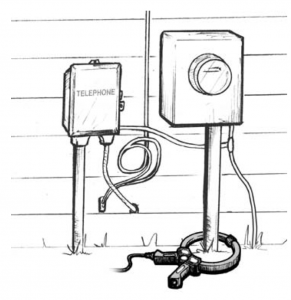
Using a Signal Clamp
If you can’t directly connect to the target, another way is to use a Signal Clamp with the 800 series transmitter. If using the 800-HL or dual frequency transmitter, both frequencies are emitted from the clamp. The clamp will induce the majority of it’s signal(s) onto the conductor(s) that it is clamped around, thus minimizing the signal on the adjacent conductors. This gives you more options for finding the target conductor.
Inductive Locating with High Frequency
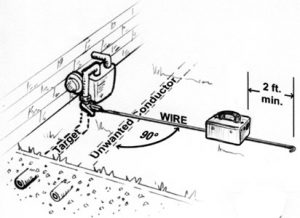
If you have a place to hook up to, connect a wire to the target conductor and lay it out perpendicular to the other conductors. Place the transmitter on the wire, a few feet from the end. The wire acts as part of the conductor and in that position the transmitter will put a much stronger signal on the target conductor vs. the adjacent conductors.
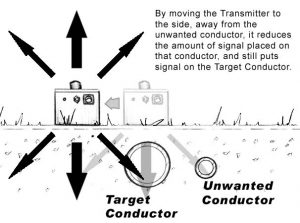
In a lot of cases, you can simply move the transmitter slightly to the opposite side of an adjacent conductor. This puts a slightly weaker signal on the target conductor but also significantly weakens the signal put on the adjacent conductor.
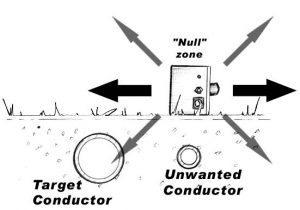
If there are two lines causing confusion you can place the transmitter on its side in “null” position over the unwanted conductor. This will put a signal on the target conductor and make the unwanted adjacent conductor nearly disappear.
Why Verification Matters
Equipment and Signal Control
Modern locating equipment helps operators distinguish between usable signal and stray signal. Clear receiver response, stable peak location, and predictable direction change are indicators the signal is isolated.
Frequently Asked Questions