
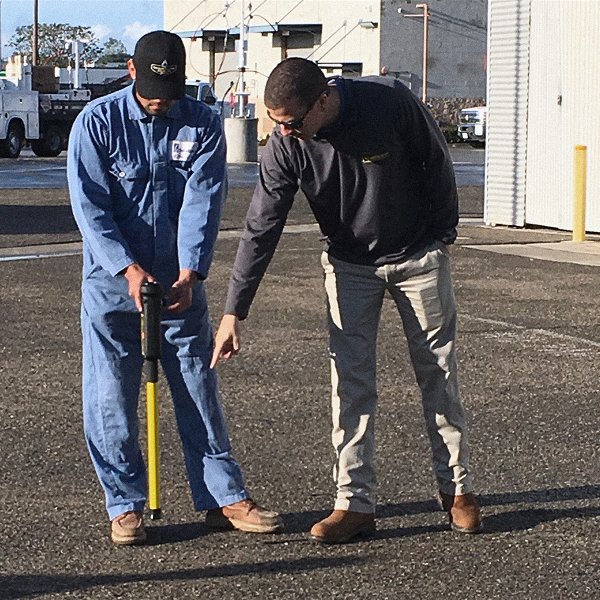
WHAT PINPOINTING MEANS IN UTILITY LOCATING
Pinpointing is the process of identifying the exact center of a buried utility line by locating the strongest point of the electromagnetic signal field. A transmitter sends a signal onto a conductor such as a pipe, cable, or tracer wire, and a receiver detects that signal from the surface. The signal response peaks directly over the utility path, allowing the operator to trace the line accurately.
IN SIMPLE TERMS
The receiver is not finding the pipe itself — it is finding the signal around the pipe. The center of that signal field sits directly above the utility. Pinpointing means walking the receiver across the signal and locating the narrowest, strongest point.
WHY PINPOINTING MATTERS IN THE FIELD
Accurate pinpointing helps excavation crews expose the correct utility faster, reduces re-locates, and improves confidence in the marks left behind. Consistent centering also helps crews work more efficiently in congested corridors where multiple utilities run close together.
Keeps marks tight and repeatable
Helps excavation crews expose the correct line faster
Reduces confusion in congested utility corridors
Improves confidence in the locate path
WHAT THE RECEIVER IS ACTUALLY DETECTING
A utility locator does not detect the pipe or cable itself. The transmitter places an electrical signal onto a conductive path, and that signal creates an electromagnetic field around the utility. The receiver senses this field. The strongest response occurs directly above the conductor, which allows the operator to trace the path from the surface.
Locators using ultra-high frequency can often maintain signal response even when tracer wire is damaged or difficult to access. The Pipehorn 800‑HL Pipe and Cable Locator was designed for these real-world field conditions and helps keep the signal readable along the utility path.
STEP-BY-STEP PINPOINTING METHOD
To properly pinpoint a pipe or conductor using a Pipehorn pipe and cable locator, you want to hear the signal fall off on both sides of the conductor. You will either get a balanced signal, meaning it falls off evenly on both sides of the strongest signal; or an un-balanced signal, meaning it falls off faster on one side vs. the other (as shown below). An un-balanced signal usually means you are picking up more than one conductor.
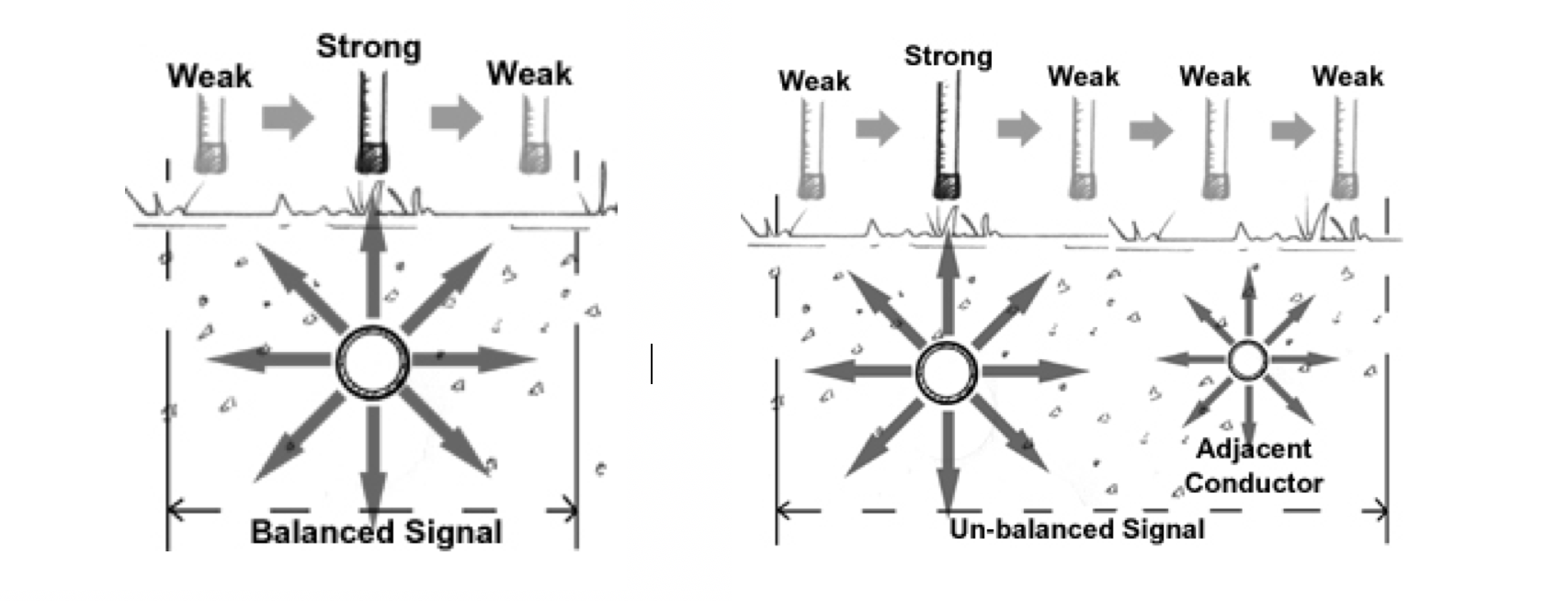
If the receiver is beeping, you need to turn the gain down. This will allow you to narrow the gap. You also need to keep the receiver level during pinpointing; do not swing the receiver during pinpointing.
When locating on a steep hill or bank, you want to still try to keep the receiver as level as possible, otherwise you will miss your mark as shown below. Remember that your strongest signal comes from when the sensor is closest to a conductor. This may not be straight down on a hillside, but off to the side.
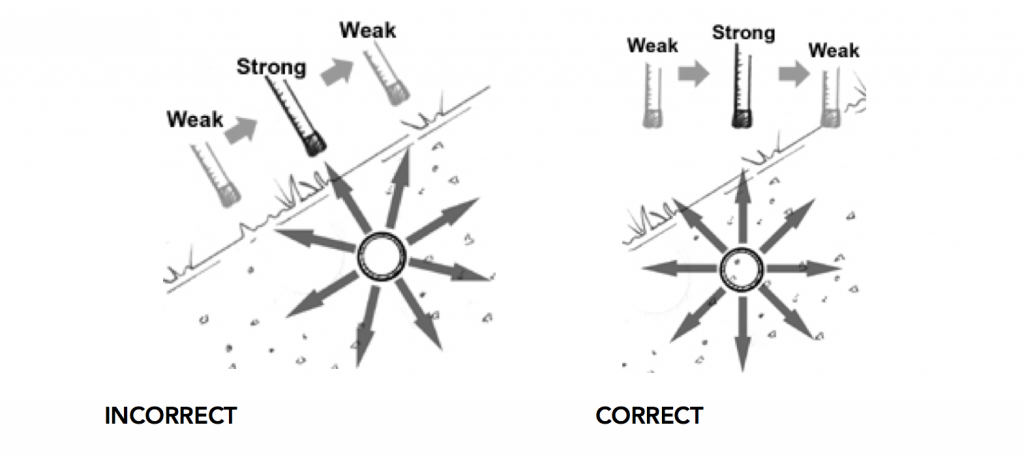
The deeper the conductor is, the worse this problem becomes.
If you’re training new locators or improving field accuracy across a crew, a locator designed for clear signal response can make pinpointing far more consistent. You can learn more about how the Pipehorn 800-HL works in the field here.
COMMON PINPOINTING PROBLEMS LOCATORS EXPERIENCE
Wide or unclear signal response
Peak shifts while tracing the line
Signal disappears at crossings
Difficulty staying centered over the utility