

What Pinpoint Accuracy Really Means in Utility Locating (and How to Achieve It)
In utility locating, accuracy is everything. Crews depend on clear, reliable marks to dig safely, avoid damage, and keep projects moving. But “pinpoint accuracy” is often misunderstood.
True pinpoint accuracy in utility locating comes from understanding how the signal behaves, choosing the right frequency, and using consistent locating techniques. When those pieces come together, accuracy becomes repeatable and reliable in the field.
Why Pinpoint Accuracy Matters
When a locate is off, even by a small amount, the consequences add up fast.
Inaccurate marks can lead to:
- Missed or offset marks
- Extra verification passes
- Slower production
- Increased damage risk
- Loss of confidence in the locate
When marks are off, crews either stop and recheck or move forward with uncertainty. Neither option is good. Pinpoint accuracy helps crews work faster while staying confident in what is below the surface.
Common Causes of Inaccurate Locates
Before talking about how to improve accuracy, it helps to understand why locates go wrong in the first place.
Some of the most common causes include:
Signal Bleed
When the signal jumps to adjacent utilities, the locator may be tracing the wrong line. Strong signal does not always mean that it is the correct signal.
Poor Grounding
A weak or inconsistent return path can distort the signal. This often shows up as a signal that wanders instead of staying centered, or one that’s difficult to pinpoint.
Wrong Frequency Selection
Using a frequency that is too low may fail to carry the signal. Using one that is too high without control can create signal bleed. Accuracy starts with choosing the right frequency for the situation.
Rushed Technique
Skipping verification passes or relying on a single sweep can lead to marks that look fine on the surface but are off below ground.
What Pinpoint Accuracy Really Means in Utility Locating
Pinpoint accuracy means identifying the conductor directly below the receiver—not just finding a signal somewhere in the area.
True pinpoint accuracy means:
- A clear peak directly over the conductor
- Even signal drop-off on both sides of that peak
- Consistent tone behavior as you walk the line
- The ability to verify direction and source of the signal
Accuracy is confirmed when the signal behaves the same way every time you pass over the line.
The Four Pillars of Pinpoint Accuracy
1. Choosing the Right Frequency
Different locating situations call for different frequencies.
Low-frequency signals are effective for isolating a single conductor and tracing long distances on good conductors. High-frequency signals perform better on poor conductors, short runs, or lines with breaks or insulated joints.
Having access to both frequencies in a dual-frequency pipe and cable locator allows crews to:
-
- Continue tracing when one frequency stops
- Jump breaks in the line
- Confirm the correct line when multiple utilities are present
Accuracy improves when frequency selection in utility locating is intentional, not automatic.
2. Signal Control
Pinpoint accuracy comes from controlling the signal during utility locating and dialing it in.
As the receiver approaches the conductor, the tone should rise to a clear peak and then fall away evenly on both sides. If the tone stays constant or begins to beep, sensitivity is too high and accuracy suffers.
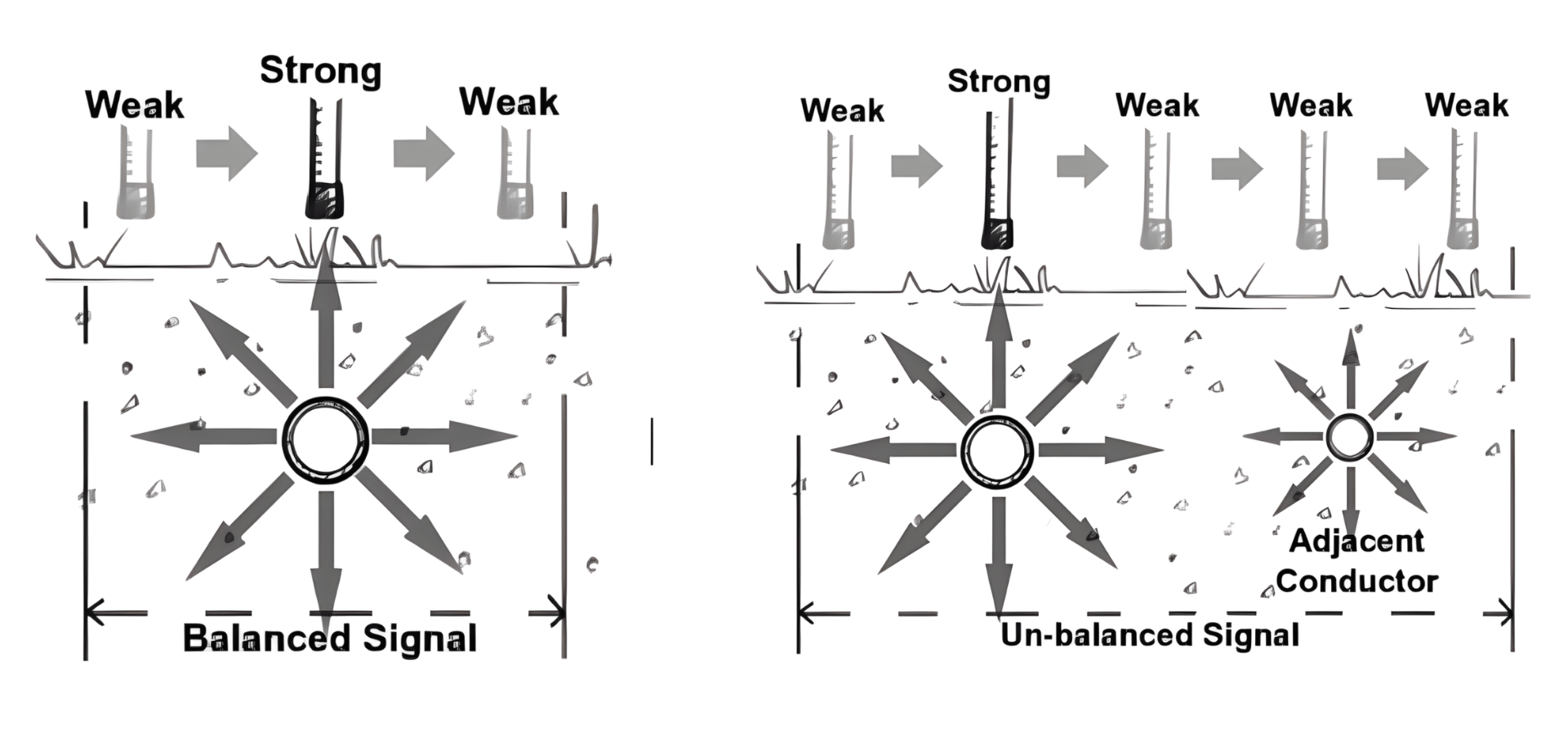
Example of a balanced signal versus an unbalanced signal caused by interference or excessive sensitivity.
Lowering sensitivity, or gain, tightens the signal field and makes the true center easier to identify.
3. Proper Grounding and Return Path
During conductive locating, grounding plays a major role in signal clarity.
Placing the ground rod far away and at a right angle from the conductor helps focus the signal on the target line and reduces interference from adjacent utilities.
Whenever possible:
-
- Place the ground stake in moist soil
- Keep distance from other utilities
- Avoid rushed or compromised grounding setups
Proper grounding for conductive locating helps focus the signal on the target line and reduce interference.
4. Consistent Pinpointing Technique
Technique matters as much as locating equipment.
Accurate pinpointing includes:
-
- Holding the receiver vertically and in line with the conductor
- Watching for a LOW-HIGH-LOW tone pattern
- Making multiple passes to confirm the peak
- Keeping the receiver level, especially on slopes or uneven ground
Accuracy improves when proper pinpointing technique becomes habit.
How Modern Locators Improve Accuracy
Today’s locating equipment is designed to help crews achieve better accuracy with less guesswork.
Features that support pinpoint accuracy include:
- Ultra-high frequency capability for difficult locates
- Stable signal output for consistent tracing
- Clear, simple displays that help confirm peaks
- Straightforward controls that allow quick adjustments in the field
- When locators are built for real-world conditions, pinpoint accuracy becomes easier to achieve job after job.
Field Takeaway
Pinpoint accuracy is the result of using the right frequency, controlling the signal, setting up proper grounding, and applying consistent technique.
When accuracy is treated as a process instead of a device setting, locates become clearer, crews move faster, and confidence in your locate increases,
That is what pinpoint accuracy really means in the field.