
Every crew knows the challenges: inaccurate maps, unreliable tracer wire, and buried lines hidden under years of repairs and paving. In those environments, locating accuracy matters. It keeps work on track and crews out of harm’s way.
Pipehorn was built with one simple goal: to solve the problem of locating underground utilities in a simplified and safe manner. That purpose has shaped every decision since the first Pipehorn locator was built more than fifty years ago.
This is the story of the field challenge that sparked the original design and how listening to working locators continues to guide Pipehorn’s product development today.
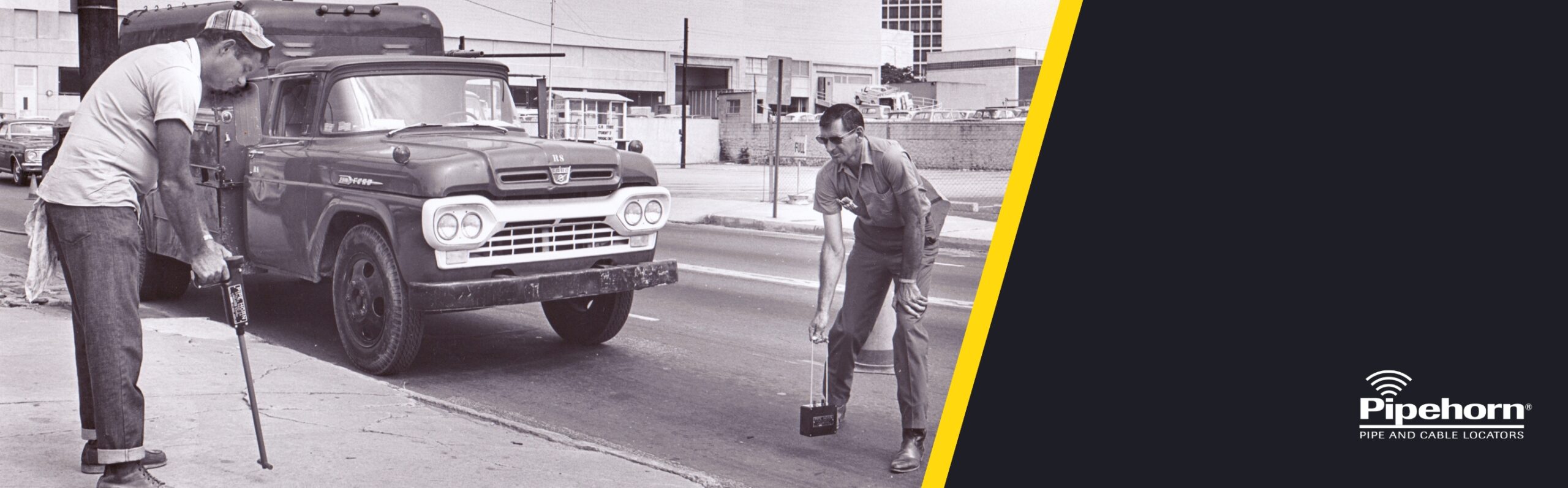
In the late 1960s, crews struggled to locate cast iron gas and water lines with the equipment available at the time. Signals cut in and out and readings were inconsistent. This resulted in missed lines which slowed jobs and increased risk. Crews needed equipment that worked reliably in various soil conditions.
Tom Humphreys, an engineer at Alabama Gas Company, saw this problem and acted.
Humphreys designed and patented the first Pipehorn locator in 1968 to give crews a stronger signal and a simpler way to trace cast iron pipe with insulated joints. The design focused on field performance, durable construction, and easy-to-use controls – and you could use it standing up!.
The Pipehorn locator caught on because it worked. Users trusted it, and that trust became the starting point for a company built around practical, field-proven equipment.
From the beginning, Pipehorn built its equipment around the needs of working locators, and the company believed that the best ideas came from real jobsites. Crews shared where they were losing time, which materials made signals difficult to track, and what they needed the equipment to do better. Those early conversations became the blueprint for how Pipehorn refined its controls, strengthened its housings, and improved signal response. Their feedback shaped the early designs and set the tone for how Pipehorn would improve its equipment moving forward.
Over the years, crews faced a growing mix of increasing locating challenges such as short services, inserted services, insulated joints, and broken tracer wires. These challenges created conditions where traditional frequencies struggled.
To address these problems, Pipehorn revolutionized high-frequency locating capability with its 480 kHz option. Crews needed a way to apply a usable signal on lines that were difficult to trace, especially on services that allowed very little signal to carry. The higher frequency provided a stronger response on those trouble spots and gave locators a workable signal where it had been hard to get one before. It was a practical step that came directly from what crews were seeing in the field.
Jobsites demand equipment that is fast to set up and easy to read. Pipehorn builds with four priorities in mind:
Those priorities show up in practical ways:
The focus is always on helping locators stay safe and be more efficient in their work.
Jobsites can change by the hour. Soil conditions shift, weather turns fast, and access points are not always ideal. However, Pipehorn’s equipment is built to handle those realities. The locator relies on proven analog signal processing and a durable housing that stands up to repeated daily use. Many Pipehorn locators stay in service for decades because they continue to perform in a wide range of field conditions.
Locators rely on equipment that can withstand years of hard handling. Rugged aluminum housings protect internal components, straightforward controls reduce the chance of breakage, and battery life supports long days in the field. These design features are intentional, as they allow crews to stay productive without worrying about whether the equipment can keep up.
Tough conditions don’t stop when equipment needs service. When repairs are required, Pipehorn locators are serviced by experienced technicians who understand both how the equipment is built and how it’s used in real jobsite conditions. Each unit is fully inspected, updated as needed, and returned to original performance specifications, or better.
Pipehorn locators are backed by a 3-year warranty, require no periodic calibration or scheduled maintenance, and feature a 2-business-day repair turnaround to minimize downtime. Fast, knowledgeable service helps ensure Pipephorn locators spend less time in the shop and more time working where they’re needed, out in the field.
Pipehorn began with a single invention, but its mission has remained the same for more than fifty years: build reliable utility locating equipment that performs in the field. The company focuses exclusively on locators, and nothing else, which allows every design to center on durability, accuracy, and long-term performance. Features are added only when they improve results, not when they add unnecessary complexity.
Pipehorn remains privately held and continues to engineer, manufacture, support, and distribute its equipment from Birmingham, Alabama. Keeping everything under one roof ensures consistent quality and builds a team with deep product and field knowledge. When locators call, they talk with someone who understands the job. That connection has helped build trust with crews across the country.
Ready to see how Pipehorn equipment performs on your jobsites? Connect with our team in Birmingham, backed by years of hands-on knowledge who are ready to support your crew.
Damage Prevention

Damage Prevention